
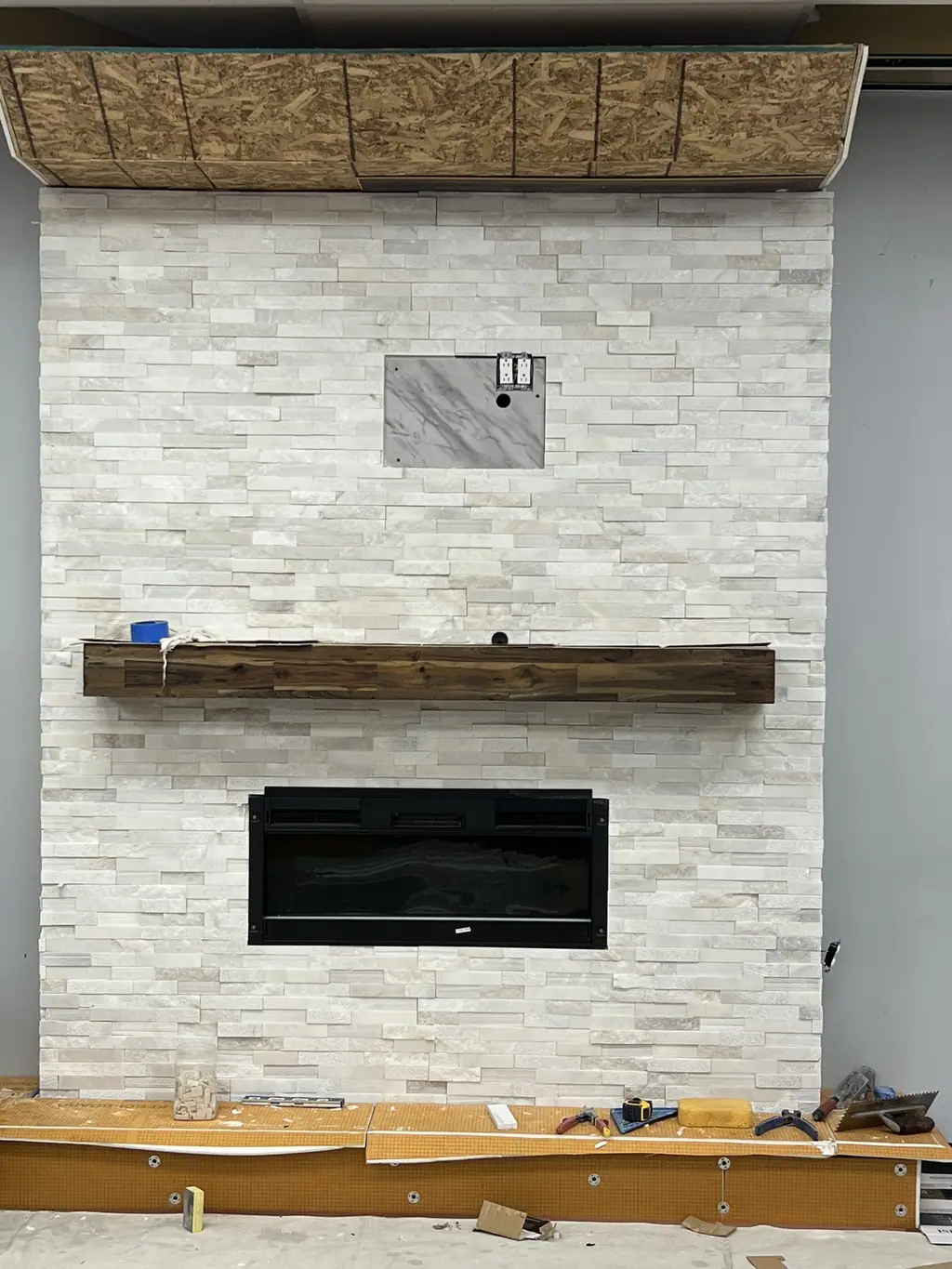
Stone is everywhere in Central Bucks, from fieldstone farmhouses and bank barns to stone-faced fronts on newer colonials. F2 Home Improvement installs stone veneer in Doylestown, PA on fireplaces, interior accent walls and exterior foundations and bases. It's a smaller part of our work than tile, and our past stone work includes a stacked-stone fireplace surround, but the skills carry over: a sound substrate, the right bonding mortar and a layout that looks natural from across the room.
We work with two kinds of material. Manufactured stone is cast concrete, colored to look like stone, and light enough for most walls. Natural thin stone is real quarried stone sawn to roughly an inch thick, with color all the way through and the weathered texture of the real thing. Both need the same attention to what's behind them.
Matching the look of Bucks County stone
A lot of Doylestown-area homeowners want new stone to sit comfortably next to the local fieldstone: irregular shapes in tans, grays and browns, set with fairly wide mortar joints. Manufactured lines sold as fieldstone or ledgestone can get close, but natural thin stone usually matches an old farmhouse wall more convincingly. We bring samples outside and hold them against your existing stone in daylight, because color reads very differently indoors.
Southeastern Pennsylvania has seen plenty of moisture damage behind stucco and stone veneer that went up without proper drainage details, including on homes in newer Central Bucks subdivisions. When we add veneer to an exterior wall, the water-resistive barrier, lath, weep screed and flashing get as much attention as the stone itself.
Inside Doylestown Borough's historic district, exterior changes visible from the street may need review by the borough's Historical and Architectural Review Board. If your home is in or near the district, check with the borough before choosing materials.
What we handle
Fireplace surrounds
Stacked stone or fieldstone-style veneer on fireplace walls and chimney breasts, with hearth and mantel details planned around the stone.
Interior accent walls
Feature walls in family rooms, basements and entries, installed over cement board or metal lath rather than bare drywall.
Exterior foundation skirts
Veneer over exposed concrete or block foundations to tie a newer house into the stone look of the area.
Porch columns and piers
Wrapping column bases and piers, with cap stones that shed water.
Exterior wall sections
Front elevations and bump-outs, installed over a drained wall assembly.
Substrate preparation
Water-resistive barrier, lath, scratch coat and weep screed installed to the veneer manufacturer's instructions.
How the project runs
Walkthrough & estimate
We look at the wall, what it's made of and how water moves around it, and give you a written estimate.
Stone selection & mockup
You choose the stone and mortar color, and we lay out a sample section on the ground so you can see the pattern and joints first.
Substrate & flashing
Barrier, flashing, lath and scratch coat go on and cure before any stone is set.
Setting & pointing
Stone is set with corners first, joints are filled and tooled to the style you picked, and the wall is cleaned.
Final walkthrough
We go over the finished wall with you, including where to keep mulch and soil back from the base.
Details that decide how exterior veneer holds up
Clearance at the base. Veneer manufacturers call for the bottom of the stone to sit several inches above soil and a smaller distance above paved surfaces, ending at a weep screed so water can drain out. Stone buried in a mulch bed is a common cause of trouble.
Flashing at every interruption. Windows, doors, deck ledgers and roof-to-wall joints all need flashing that directs water out over the stone. Freeze-thaw cycles through a Bucks County winter find any spot where water sits behind the veneer.
Interior fireplaces. Veneer around a firebox has to follow the stone maker's heat and clearance guidance, and a heavy natural stone wall needs a substrate that can carry the weight. Our post on exterior stone veneer on Bucks County homes covers the wall assembly in more detail. When you're ready, ask for a free estimate.
Areas we cover around Doylestown
- Doylestown Borough
- Doylestown Township
- Buckingham Township
- Plumstead Township
- Solebury Township
- New Hope
- Warwick Township
- New Britain
- Chalfont
- Furlong
Stone Veneer in Doylestown: FAQ
Can new stone match the fieldstone on our farmhouse?
It can come close. Natural thin stone from a similar rock type is usually the best match, and mortar color and joint style matter as much as the stone. We set out a sample panel next to your wall so you can judge it before we order.
Can stone veneer go straight onto drywall for a fireplace wall?
We don't recommend it. Most manufacturers call for cement board or metal lath with a scratch coat, which gives the mortar something to grip and handles the weight. Around a firebox, noncombustible backing is required anyway.
Our 2000s home already has stone on the front. Should we be concerned about water behind it?
Worth checking if you see staining below windows, soft or swollen trim, or stone that meets the ground or a roof line with no visible weep screed or flashing. A moisture inspection by a building envelope inspector is the way to know. We don't do invasive testing ourselves.
Does exterior stone veneer need a permit?
It depends on the scope and your municipality. Adding veneer to a foundation skirt is treated differently from re-cladding a wall. We check with your township or borough code office, and in the borough's historic district we point you to the review board first.
Related reading
Exterior Stone Veneer on Bucks County Homes: What to Know
Natural or manufactured stone, the drainage layers behind it, and the details that decide whether exterior veneer on a Bucks County house lasts through freeze-thaw winters.

Stone Veneer Fireplaces for Chester County Homes
Stone veneer can turn a plain brick or drywall fireplace into a room's focal point. Here is how to choose the stone and what the installation requires.