
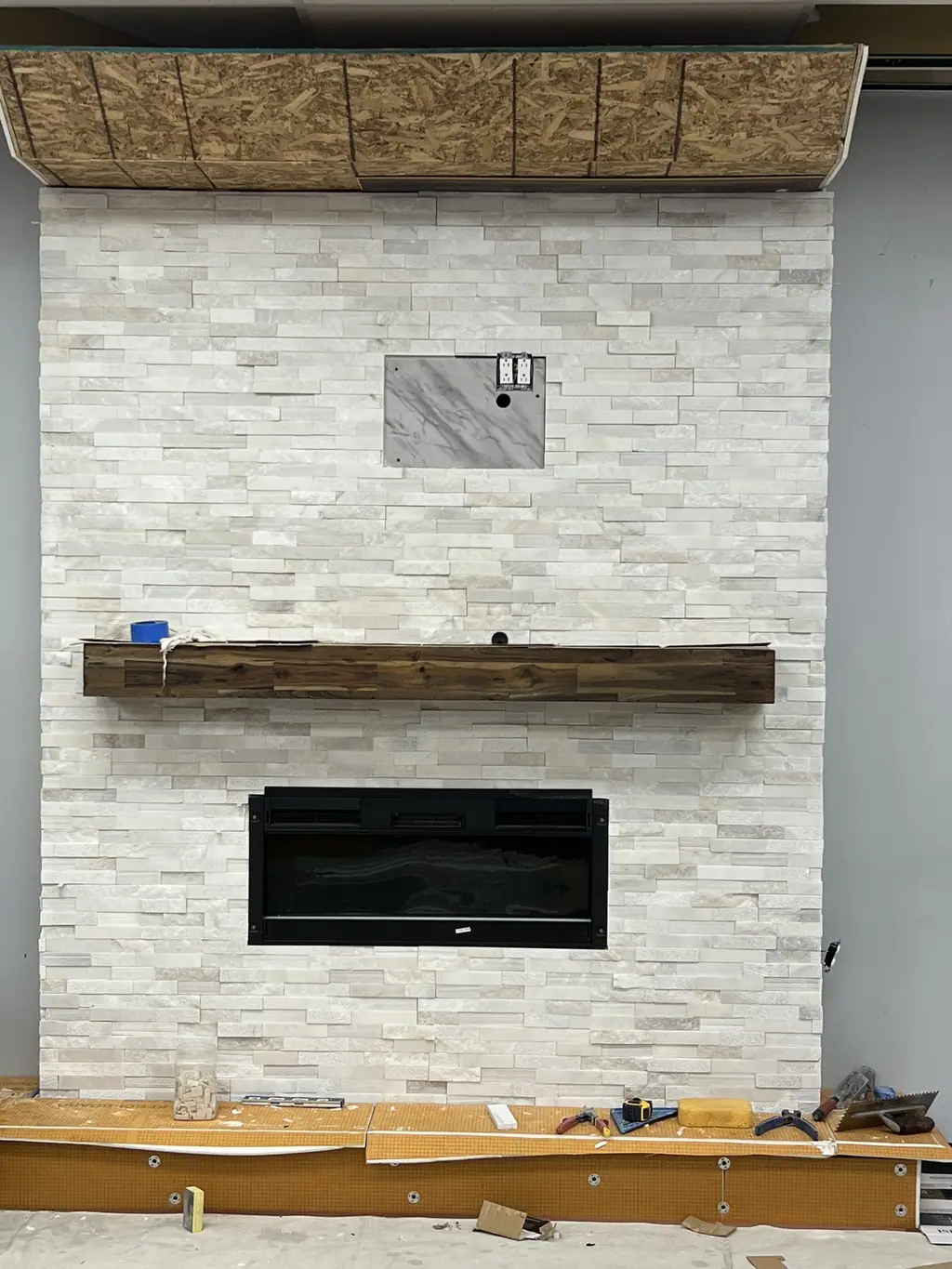
Stone veneer installation in Newark, DE is something F2 Home Improvement offers on a smaller scale than our tile work. Our past stone jobs include a stacked-stone fireplace surround, and we've spent more than ten years setting heavy, irregular material on walls, which is most of what veneer comes down to. We'll be straightforward about what fits our experience and what doesn't.
Thin stone is laid in mortar over a prepared wall. Indoors, that can mean cement board or a scratch coat over lath. Outdoors, it means a full drainage assembly behind the stone, because water will get behind it. The stone itself is the easy part to pick; the substrate and the details at the edges are what decide whether it lasts. Our main stone veneer page covers the materials.
Where stone veneer makes sense in Newark homes
Many split-levels around Newark have a brick fireplace in the lower-level family room, often dark red brick with a raised hearth that hasn't changed since the 1960s or 1970s. The 1970s and 1980s colonials around Pike Creek and Hockessin commonly have a brick or plain drywall fireplace wall in the family room. Covering that wall with stacked stone or a ledgestone profile, and rethinking the mantel, is the most common stone project we're asked about.
On the outside, some ranches and split-levels in the area have a band of brick or plain siding along the front foundation that owners want to change. Exterior veneer can work there, but it's a different job from a fireplace. Delaware's freeze-thaw winters and wet springs are hard on any exterior assembly that traps water, so flashing, weep screed and clearance from grade and hardscape have to be right.
What we handle
Fireplace surrounds
Stacked stone or ledgestone over existing brick or new backer, with attention to how the stone meets the firebox, hearth and mantel.
Interior accent walls
Stone on a TV wall, a basement bar or a stair wall, with the wall checked for the added weight.
Hearth and mantel work
Resurfacing or rebuilding a hearth and setting a wood or stone mantel as part of the veneer layout.
Exterior bases and wainscot
Stone along foundation walls or columns, over a water-resistive barrier, lath and scratch coat with a weep screed at the bottom.
Manufactured and natural thin stone
Lightweight manufactured stone and natural thin-cut stone, with corners that wrap edges instead of showing cut ends.
Surface prep
Cleaning and roughening painted or sealed brick, or covering it with lath and scratch coat so the mortar bonds.
How the project runs
Walkthrough & estimate
We look at the wall, what it's made of and what's behind it, and check fireplace clearances and exterior drainage. The written estimate is free.
Stone selection
We help you compare profiles and colors, ideally with a sample board you can look at in the room's actual light, and figure out corner pieces and trim.
Substrate prep
The wall is prepared for bond: cleaning brick, installing lath and scratch coat, or adding cement board. Outdoors, the drainage layer and flashing go in first.
Setting the stone
Stones are laid out on the floor first, then set in mortar with joints kept consistent and the pattern kept random so no two identical pieces sit side by side.
Grout, clean and review
Joints are finished to the look you picked, mortar is cleaned off the face and we go over the result with you.
Details that decide how stone veneer holds up
Painted or sealed brick won't hold mortar well. If your fireplace brick has been painted, we either remove enough of the paint to get a sound bond or install metal lath and a scratch coat over it. Setting stone directly onto paint is a common reason veneer comes loose.
Heat and clearance matter at the firebox. Stone veneer is noncombustible, but the mantel and anything wood around it must keep the clearances your fireplace or insert manufacturer requires. Gas inserts and wood-burning fireplaces have different rules, so we check the unit's documentation before setting a mantel height.
Exterior work needs a place for water to leave. Veneer is porous. Outdoors, it needs a water-resistive barrier, a drainage gap or mat, weep screed at the base and clearance above soil and paving. Without those, moisture sits against the sheathing. For more on exterior assemblies, see our post on exterior stone veneer; the construction details apply here in Delaware too.
Areas we cover around Newark
- Pike Creek
- Hockessin
- Bear
- Glasgow
- Christiana
- Stanton
- Brookside
- Ogletown
Stone Veneer in Newark: FAQ
Can stone veneer go right over my existing brick fireplace?
Often, yes, if the brick is clean, sound and unpainted. Painted or sealed brick needs to be stripped or covered with lath and a scratch coat first. We check the brick during the walkthrough.
What's the difference between manufactured and natural thin stone?
Manufactured stone is cast concrete colored to look like stone. It's lighter and usually less expensive. Natural thin stone is real stone cut thin, with natural color variation that won't fade, and it typically costs more. Both are set the same general way.
Do I need a permit for stone veneer in Newark, DE?
Interior veneer on a fireplace surround often doesn't, but work that changes a fireplace, chimney or exterior wall may. Addresses inside city limits are handled by the City of Newark and unincorporated areas by New Castle County. We confirm requirements with the local jurisdiction for each project.
How much stone work have you done?
Stone veneer is a smaller part of our work than tile. Our completed stone jobs include a stacked-stone fireplace surround, and we'll show you that and talk through exactly how we'd approach your wall before you decide.
Related reading

Stone Veneer Fireplaces for Chester County Homes
Stone veneer can turn a plain brick or drywall fireplace into a room's focal point. Here is how to choose the stone and what the installation requires.
Exterior Stone Veneer on Bucks County Homes: What to Know
Natural or manufactured stone, the drainage layers behind it, and the details that decide whether exterior veneer on a Bucks County house lasts through freeze-thaw winters.