
F2 Home Improvement installs stone veneer in Media, PA on fireplace surrounds, interior feature walls and the lower portion of exterior walls. It's a smaller part of our work than tile. Our past stone jobs include a stacked-stone fireplace, and we take on veneer projects where the substrate and details are right.
Stone veneer shares a lot with tile. It's adhered to a prepared surface with mortar, laid out so the pattern looks natural, and finished at the edges where it meets trim, mantels or siding. The differences are weight, joint style and, outside, how water is managed behind it.
Matching stone in a county built of it
Delaware County has a long history of building with local stone. Many older houses around Media, Swarthmore and Rose Valley have walls of gray, mica-flecked schist or fieldstone, and some newer homes and additions nearby try to echo that look. If your goal is to tie a new fireplace or foundation skirt to existing stone, bring us to see it. Some manufactured profiles come close; others clearly don't, and it's better to know before ordering.
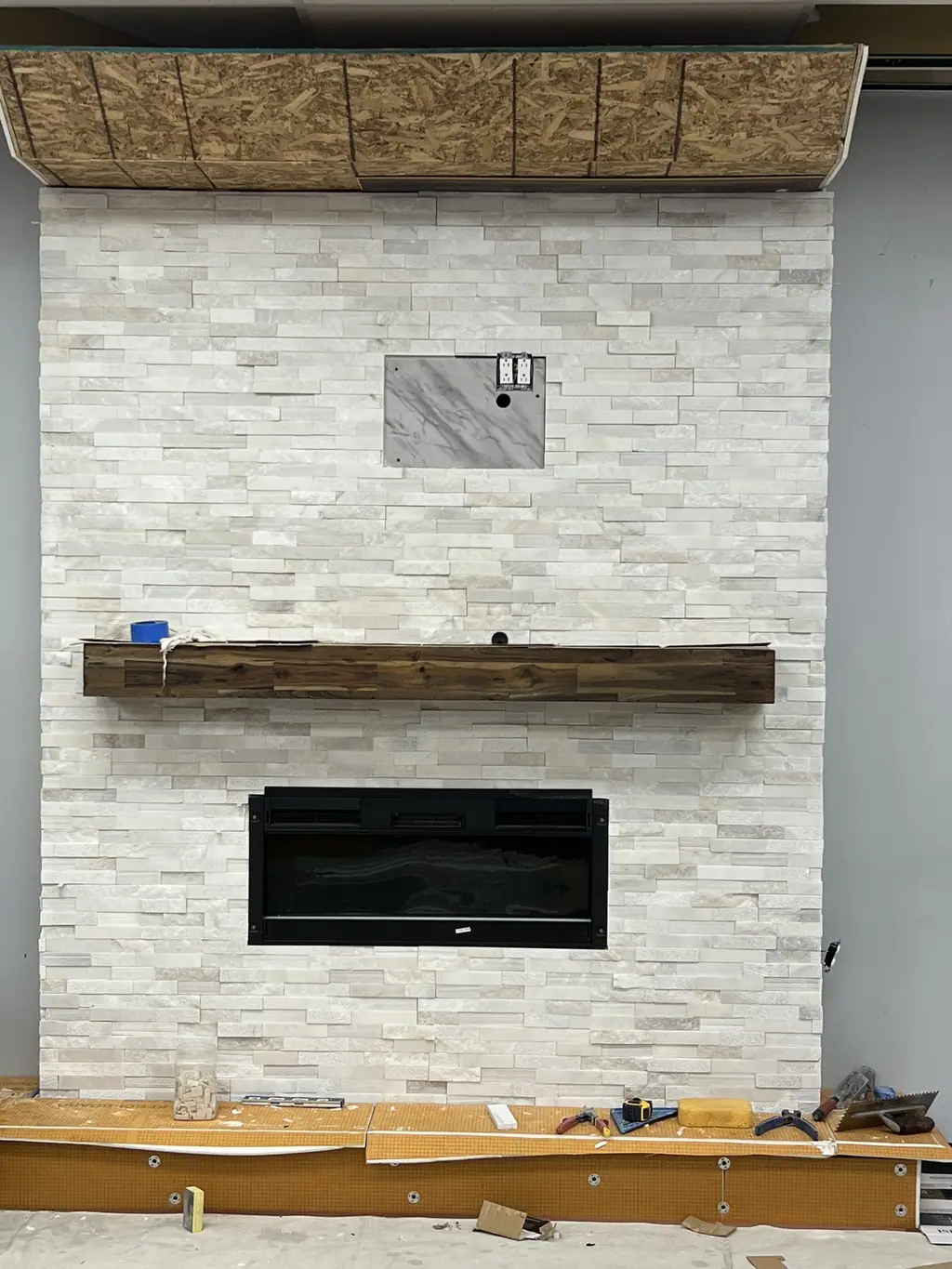
Inside, the most common request is a fireplace surround in a 1960s or 1970s living room where the original brick or painted drywall no longer suits the space. Stacked ledgestone and drystack profiles are popular there, and they go over properly prepared brick, masonry or cement board.
Outside, veneer faces freeze-thaw cycles and heavy rain. Getting the water-resistive barrier, lath, and weep screed or drainage detail at the base right matters more than the stone you choose.
What we handle
Fireplace surrounds
Stacked stone and fieldstone looks over brick, block or cement board, with clearances kept around the firebox.
Interior accent walls
Feature walls in living rooms, basements and bars, on framing checked for the added weight.
Exterior foundation skirts
Stone on the lower portion of a wall, detailed with a water-resistive barrier, lath and a drainage path at the base.
Column and pier wraps
Stone around porch columns, mailbox piers and posts.
Hearths and caps
Flat stone hearths, sills and caps to finish the top and edges of a veneer installation.
Surface prep
Removing old finishes, installing cement board or metal lath and scratch coat as the substrate requires.
How the project runs
Walkthrough & estimate
We look at the wall or fireplace, what's behind it and how the edges will finish, and give a written estimate.
Stone selection
You choose a profile and color, ideally with samples held against the room or existing stonework in daylight.
Substrate preparation
The surface is cleaned or rebuilt, and lath, scratch coat or cement board is installed as needed.
Setting and finishing
Stone is laid out dry, set in mortar, cut to fit around openings, and pointed or left drystack depending on the style.
Details that decide how veneer holds up
Manufactured stone veneer can trap water behind it if the barrier and base details are wrong, and that trapped water damages sheathing and framing over time. Manufacturers call for clearance above soil and paving, a proper drainage path at the bottom, and flashing where veneer meets windows, doors and decks. We follow those installation instructions and won't set stone directly over bare sheathing.
For fireplaces, the firebox opening and any required clearances to combustible materials come first. Gas inserts and wood-burning fireplaces have different rules, so bring the fireplace or insert documentation if you have it.
Cost depends on the square footage, stone type (natural thin stone generally costs more than manufactured), the number of corners and cuts, and the prep the wall needs. Interior veneer usually doesn't need a permit; exterior work or structural changes may, depending on your borough or township.
Areas we cover around Media
- Media Borough
- Swarthmore
- Rose Valley
- Wallingford
- Upper Providence Township
- Newtown Square
- Broomall
- Edgmont Township
Stone Veneer in Media: FAQ
Can you put stone veneer over our painted brick fireplace?
Often, yes. Paint has to be removed or the surface roughened and prepped, or metal lath and a scratch coat installed, so the mortar has something to bond to. We check the brick's condition first.
Will new veneer match the old stone on our house?
Exact matches to original schist or fieldstone are hard. Sometimes a natural thin stone gets close; sometimes a contrasting stone looks more intentional. We'll be honest about how close a sample comes once it's next to your wall.
How heavy is stone veneer?
Manufactured veneer is much lighter than full-bed stone and usually doesn't need a footing, but it still adds real weight. On interior framed walls we check that the wall and fasteners can carry it.
Does exterior stone veneer need maintenance?
Mostly it needs to stay dry behind. Keep soil and mulch below the bottom edge, keep gutters working and watch sealant at windows and trim. Our exterior stone veneer article covers the details.
Related reading

Stone Veneer Fireplaces for Chester County Homes
Stone veneer can turn a plain brick or drywall fireplace into a room's focal point. Here is how to choose the stone and what the installation requires.
Exterior Stone Veneer on Bucks County Homes: What to Know
Natural or manufactured stone, the drainage layers behind it, and the details that decide whether exterior veneer on a Bucks County house lasts through freeze-thaw winters.